


MILLING, MALAXATION AND EXTRACTION
MILLING
After the washing phase, the milling follows: the first real phase of the extraction of olive oil. The milling is carried out through the pressing; a modern technique where the peel, the pulp and the olive pits are reduced into a paste consisting of more or less coarse fragments. It is possible to intervene on the granulometry of the paste intensifying or not the organoleptic characteristics of the oil such as bitter and spicy. The pressing is a critical phase for the quality of the oil because this process leads to the activation of the kit enzymatic of the fruit that catalyzes various biochemical reactions that are the basis of the sensory and health characteristics of the extra virgin olive oil. Our oil mill uses a hammer crusher that reduces the olives to a homogeneous paste ready for the malaxation phase.
MALAXATION
The malaxation is the process that, through a machinery called malaxer machine, disemulsion oil and paste, collecting the liquid in bigger drops thanks to a slow movement of the mass and its heating. This is a key moment of the processing of olive oil, which somehow will decide on quality, taste and also quantity: depending on the temperature at which the paste is subjected to, in fact, the oil gains or not the right to denomination “cold” and changes its organoleptic qualities. From 25 ° to 27 °, the product maintains excellent quality and can boast about the “cold” definition. Between 27 ° and 30 ° and over, the production will grow in quantity, but the product will be mediocre, as it will have lost its fruity taste and various key substances, such as polyphenols. In our oil mill, the latter takes place with using temperatures that do not exceed 27 ° in general (this is called cold malaxation) and for a time of about 30 minutes, thus maximizing the organoleptic, olfactory and taste characteristics of the oil.
EXTRACTION
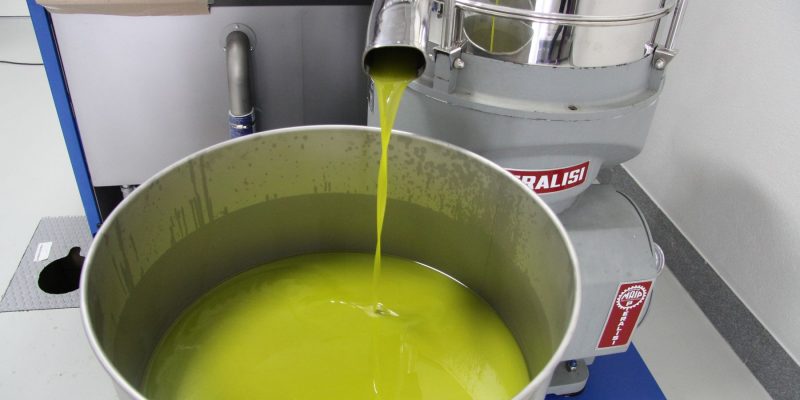
Extraction is the process that finally sees the appearance of a product similar to the oil we know: even in this case there are different techniques to bring this stage of olive oil production to fulfillment. In our oil mill, this process takes place through volumetric pumps, the paste from the malaxation is ‘pushed’ to a centrifuge with horizontal blades, commonly called a decanter. To the paste a certain quantity of water (from 20 to 50 litres of water per 100 kg of paste to be centrifuged), at a controlled temperature is added, that diluting the paste, favors the subsequent separation. The decanter is made up of a drum with horizontal axis of a conical cylinder shape rotating at a speed of about 3500 rpm. For the effect of the different specific weight, the centrifugation separates three “phases”: oil must (containing a small fraction of vegetation water), vegetation water, and pomace (solid phase). Inside the drum, coaxial with it, a rotary screw at low speed (10-20 rpm minute) sends the pomace part to the exit. The last phase in the production of olive oil is the separation: after the extraction of the liquid from the paste, the must obtained contains still a small amount of water, which will be separated by exploiting the non-miscibility of the light oil, and the water. This process is carried out mechanically thanks to centrifugal separators that make the separation thanks to the high-speed rotation. The liquid that comes out of the machinery is finally it: olive oil.


